The Most Under-Rerated Energy Stock Nobody Is Talking About
A $56M market cap sitting on top of the only domestic helium hub in the western United States, right as Iran just took out a third of the world’s helium supply.
On February 28, 2026, U.S. and Israeli airstrikes on Iran triggered retaliatory drone attacks on Qatar, where QatarEnergy halted production at Ras Laffan and declared Force Majeure on helium deliveries days later. Qatar supplies roughly one-third of global helium. There is no substitute. You cannot synthesize it cheaply. It cools MRI machines, superconducting magnets, and is non-negotiable in semiconductor fabrication. One of only two plants producing semiconductor-grade helium just went dark with no restart timeline and a shooting war next door.
The market’s response? U.S. Energy Corp. ($USEG) is sitting at $1.06 with a $56.25 million market cap. The stock has not rerated. It has barely moved. That is the thesis.
What USEG Actually Is
USEG is not a dying stripper-well operation. It controls the Big Sky Carbon Hub atop the Kevin Dome in Montana, the only integrated helium and CCUS hub in the northwest United States. The asset runs three independent revenue streams: helium production, carbon management via $85/ton Section 45Q federal tax credits, and oil production from the adjacent Cut Bank field, with 70 million barrels of incremental CO2-enhanced recovery potential across 170+ already-permitted Class II injection wells.
And critically, USEG has not exited oil. Many assume the pivot to helium and carbon means oil is gone. It is not. The Cut Bank field is actively producing at 240 BOPD today, with a low 3-8% annual decline rate versus 25-40% for shale. The oil business is funding the platform buildout while helium and carbon come online. The EOR upside is enormous and fully permitted.
The helium resource is 1.3 BCF, Ryder Scott certified. The CO2 resource is 444 BCF. The gas stream is 87.5% CO2, meaning carbon is not a cost, it is a second revenue line off the same wellbore.
The Helium Price Setup
Here is what most people are missing. Helium is not exchange-traded. There is no ticker, no live spot feed, no futures market. Pricing is set through long-term confidential contracts between a handful of suppliers and the industrial gas majors, which is exactly why retail markets have been slow to react. The opacity is a feature of the market structure, not a bug, and it cuts both ways: prices stay suppressed longer than they should, and then they gap.
What we know is that helium was already coming off peak pricing. The 2022-2023 supply crunch pushed industrial-grade helium to $375-$450/MCF, with distressed spot cargoes trading as high as $1,000/MCF. Since then, improved domestic production, BLM reserve drawdowns, and softening demand from fiber optics and semiconductors pulled prices back toward the $280-$300/MCF range heading into early 2026. The equity has tracked that softness. Markets anchored to a declining price trajectory and stopped thinking.
That is about to change. Contract prices do not reprice instantaneously when a Force Majeure gets declared. There is always a lag, especially in a market where volumes are thin and buyers are locked into allocation windows. What happens next is not complicated: supply chain buffers get drawn down over weeks, end users start scrambling, and then the market reprices hard. Semiconductor fabs and MRI manufacturers do not have the luxury of waiting. They will pay whatever it takes.
When helium reprices, and it will, the equity has two things going for it simultaneously: a re-rating on the supply narrative and a direct increase in the forward revenue assumptions underpinning that $80 million PV-10 figure. The current price deck in management’s projections assumes $205/MCF. Depending on how this crisis evolves, that number could look conservative very quickly.
They Did Not Exit Oil. They Upgraded It.
The most common misconception floating around right now is that USEG sold off its oil business to fund the helium pivot. That is not what happened. Cut Bank is 100% owned, actively producing, and quietly becoming the most important piece of the whole platform.
The field is currently running at 240 BOPD with a 3-8% annual decline rate. For context, that is not a typo. Shale wells decline at 25-40% per year. Cut Bank conventional production declines at a fraction of that, which means the cash flow is predictable, low-maintenance, and designed to fund platform buildout while helium and carbon come online. At year-end 2025, the company reported 1.5 million barrels of proved developed producing reserves with a PV-10 of $18.4 million at SEC pricing. That alone covers nearly half the current enterprise value before you touch a single molecule of helium.
The real upside is what comes next. USEG does not need to drill new wells to grow oil production. It needs to start injecting CO2. The same gas stream producing helium is 87.5% CO2, which means USEG has a captive, company-controlled CO2 supply sitting next door to a field with 70 million barrels of incremental recovery potential and 170+ Class II injection wells already permitted. The EOR project turns a byproduct into a recovery mechanism, at zero cost of supply.
Most EOR operators have to buy or transport CO2. USEG makes it on-site as a co-product of the exact operation they are already running. That is a structural cost advantage that does not show up in any current valuation because the market has not gotten there yet.
The oil business is not a legacy hangover. It is a funded, low-decline cash engine with an EOR kicker that could redefine the production profile entirely once CO2 injection begins. The company that people think exited oil is sitting on one of the more interesting conventional EOR setups in the domestic market right now.
Financials and Capital Structure
The balance sheet is clean. Zero debt. Following the recently closed equity offering, the company holds $15.4 million in cash with $22.9 million in total available liquidity. Management’s latest filing states they have sufficient capital to fund operations through their development timeline, covering gathering infrastructure, plant construction FID in Q2 2026, and first helium sales in Q1 2027.
The valuation is where it gets interesting. Enterprise value sits at roughly $44 million. Phase 1 industrial gas PV-10 alone is $80 million per Ryder Scott estimates. Add oil PDP PV-10 of $14.9 million and you have $95 million in resource value against a $44 million EV. That is a 55% discount to Phase 1 NAV before touching the 70 million barrel EOR potential or 12 years of 45Q carbon credits worth $130 million. Management projects $15 million run-rate EBITDA at Phase 1, putting the stock at 2.8x 2027E EBITDA versus 7-10x for comparable peers.
One sell-side analyst covers it. Most institutional desks cannot legally touch a $56 million float. The awareness is near zero. That is both the risk and the opportunity. Insiders own about 26% of the shares.
The Catalyst Stack
EPA MRV approvals expected summer 2026. Project financing and plant construction FID targeted Q2 2026. First helium sales Q1 2027. Each is an independent binary catalyst. MRV approval alone will likely move this stock materially.
Meanwhile the helium shortage is not hypothetical. It is happening now, with no timeline for resolution and a geopolitical situation that is getting messier by the week. USEG is a domestic, fully-permitted, zero-debt helium producer nine months from first sales. The market has not figured that out yet.
Habibi Capital
3:38 PM · Mar 15, 2026
Trivium Weekly Recap | Party Balloon Shortage
Andrew Polk
Apr 06, 2026
As semiconductor engineers know, helium ain’t just about party balloons and squeaky voices.
It’s irreplaceable in chipmaking – and global supply just took a massive hit.
This week, we want to walk you through a supply chain story that has nothing to do with tariffs or export controls – but could prove just as disruptive to China’s chip push.
It starts in Qatar: On March 18, Iranian strikes on Qatar’s Ras Laffan industrial complex – the world’s largest LNG export hub – took all production offline.
Helium is extracted as a byproduct of natural gas processing – so when Qatar’s LNG plants go dark, helium production does too.
The result? Roughly a third of the world’s helium output was wiped out in one go.
What does any of this have to do with chips? Quite a lot, as it turns out.
Helium is non-substitutable in semiconductor fabrication.
Both electronics-grade 5N (99.999% pure) and ultra-high-purity 6N (99.9999% pure) helium are critical for wafer cooling, chemical vapor deposition (CVD), atomic layer deposition (ALD), and photolithography.
The semiconductor industry accounts for roughly 20-25% of global helium demand. But it competes for supply with some formidable rivals.
Some 25-30% of global helium flows into the healthcare sector, where most is used to cool the superconducting magnets in MRI machines. Here again, either 5N or ultra-high-purity 6N helium is needed for both manufacturing and maintaining MRIs.
Other cryogenic applications – from cooling down quantum computing systems to enabling missile and submarine detection to serving as a propellant in rockets and missiles – are also hungry consumers of high-purity helium.
This matters because chip fabs are far from guaranteed to be placed above healthcare and military needs when helium supply gets tight.
So, where does this all leave China? In quite a pickle, as it turns out.
When it comes to helium, China is heavily import-dependent.
As recently as 2023, the Chinese Academy of Sciences reported that China imported more than 95% of its helium.
Matters may have improved somewhat as a new facility in Ningxia came online, but most estimates indicate that China still imports well over 85% of its helium.
Qatar – through Ras Laffan – accounts for well over half of these imports.
Russia’s share rose noticeably in Q4 2025, but it still supplied just 40% of China’s 2025 imports.
That’s not all: Unlike fertilizer and crude, China does not maintain state helium reserves – though both industry voices and expert advisors have been calling for this for a number of years now.
That leaves China directly exposed to Qatar’s supply gap.
Domestic spot prices for ultra-pure 6N helium have surged. Industry sources say they’re up 110% since the end of February, adding that most suppliers have suspended spot price quotes altogether to prioritize long-term contracts.
Prices for lower-grade liquid helium (5N) have reportedly risen by 65% since the beginning of 2026.
And mainland Chinese chip fabs are at a serious disadvantage.
Unlike leading Korean and Taiwanese players, mainland Chinese fabs are not known to maintain deep inventories, and few have invested meaningfully in helium recovery systems.
Plus, they’re under severe pressure from export controls on a wide range of advanced lithography tools, talent bottlenecks in the rapidly growing sector, and mounting margin pressure among mature-node producers.
The upshot is that Chinese fabs are likely not well prepared for a supply crunch of this kind.
Leading chip producers elsewhere in Asia may have up to six months of supply resilience due to a combination of on-site storage, long-term contracts, and helium recovery systems.
Mainland Chinese fabs – especially smaller players making the older workhorse chips that power sensors, control EV motors, and help your devices charge – could run out in a matter of weeks.
Can anyone fill the gap? Not really.
The vast majority of global helium is produced in just five countries: The US, Qatar, Russia, Algeria, and Canada.
Helium can only be commercially captured at gas fields with naturally high helium concentrations – it can’t be synthesized from other industrial processes.
With the possible exception of Russia, no major exporter has significant capacity to increase helium output in the short term.
So, what’s next?
Chinese chipmakers will need to reckon with soaring costs and an absolute global shortage of helium alongside all other buyers.
Higher spot prices will almost certainly feed into contract prices as the disruption continues.
Assuming a prolonged shortage emerges, helium suppliers may face pressure to direct limited supplies to MRI maintenance, defense customers, frontier research, and national champion chipmakers over smaller fabs.
And the disruption won’t disappear once the Strait reopens and Ras Laffan resumes operation.
Strikes on the massive facility have reportedly damaged gas processing infrastructure that produces roughly 14% of Qatar’s helium. These could take 3-5 years to repair.
Shipping prices and insurance premiums on Gulf-routed shipments have spiked sharply due to the conflict – and those costs will not disappear when the Strait reopens.
If there’s one silver lining, it’s that the crisis could finally force a reckoning in the helium sector.
This is the fifth major helium supply crisis in two decades – each time, industries and governments have failed to produce structural solutions.
Indeed, the US government completed the sale of its helium reserves in 2024, and even stockpile-obsessed China hasn’t managed to build one.
Building more resilience into the global helium supply will require years of exploration, investment, and political will.
The question now is whether this will be the crisis that finally forces a reckoning.
In the meantime, if helium hasn’t come up in your boardroom yet this month, it probably should.
Cory Combs, Head of Supply Chain and Critical Minerals Research, and Even Pay, Head of Agricultural Research, Trivium China
What you missed
Econ and finance
The Gulf crisis has sent manufacturing costs spiking – but based on manufacturing PMI data, China’s firms appear to be shrugging it off.
Despite surging costs and geopolitical volatility, all major PMI sub-indices – including production, new orders, exports, and employment – either remained in expansionary territory or improved from the previous month.
The business confidence subindex also pointed to moderately strong business sentiment, higher than levels seen in January.
At its annual earnings call, Bank of Communications (BoCom) said new mortgage applications – a timely indicator for housing activity – were roughly 15% higher in March than the 2025 average.
BoCom is one of China’s largest mortgage lenders, meaning its comments likely reflect broader trends across the banking sector.
The bank added that its outstanding mortgage balance may stop contracting this year and gradually start growing again if current momentum persists.
Business environment
On Monday, the market regulator (SAMR) rolled out a plan to enforce the Anti-Unfair Competition Law – the legal backbone of its anti-involution campaign.
Since July 2025, Beijing has been trying to curb cutthroat “involution-style” competition across sectors like EVs, solar, batteries, and food delivery.
The platform economy tops SAMR’s target list – ahead of EVs, solar, and batteries.
Regulators also pledged new regulations to crack down on unfair competition online – likely aimed at curbing price wars and predatory tactics by platforms more broadly.
Tech
On Monday, China launched the World Data Organization (WDO) in Beijing – organizers say there are already some 200 members from more than 40 countries.
The WDO’s goal is to help break down barriers by tackling globally fragmented data policies, developing standards and best practices, and helping corporates reduce data compliance costs.
It also aims to build transnational data ecosystems in key industries, including healthcare, education, and energy.
However, the WDO will not try to set binding data transfer rules as it is strictly for entity-to-entity coordination.
Politics
On Monday, Taiwan Affairs Office Director Song Tao announced that KMT Chairwoman Cheng Li-Wun will visit the mainland between April 7 and 12.
Cheng took the KMT helm last October on a platform of easing tensions and reviving cross-strait engagement.
It will be the first meeting between Xi Jinping and a sitting KMT leader since 2016, and the first time Xi has personally “welcomed and invited” a KMT chair to the mainland.
On March 27, Zhang Chengzhong, 55, was appointed Party secretary of the Ministry of Emergency Management (MEM), replacing Wang Xiangxi, who was removed for corruption.
The MEM is responsible for workplace safety and coordinates disaster prevention and response.
Zhang should be formally appointed as minister at the April legislative session, making him the youngest serving minister.
Zhang is a technocrat who spent the first two decades of his career working in subsidiaries of China National Petroleum Corporation (CNPC) – one of the world’s largest oil and gas producers – in Liaoning province.
Agriculture and rural affairs
On Friday, the macro planner (NDRC) and the ministries of commerce (MofCom) and finance (MoF) announced the launch of pork purchasing for central reserves, citing the need to ensure “stable pork market operation.”
Let’s be clear: This isn’t a wartime stockpiling effort, and Beijing isn’t bracing for a food security crisis.
China’s pig farming companies have been battling a supply glut and been locked in an involutionary price war for a while now.
Average pig prices dropped to RMB 10.68 per kilogram in the fourth week of March, down 29.8% y/y to a nearly eight-year low.
Foreign affairs
Bloomberg reported that Chinese tankers delivered shipments of diesel and distillates to the Philippines and Vietnam over the weekend, despite Beijing’s fuel export curbs imposed earlier this month.
China banned commercial exports of refined fuels in early March amid soaring prices for petroleum products resulting from the war in the Persian Gulf.
At the time, we flagged that Beijing might provide emergency relief to neighbors and allies on a case-by-case basis after domestic energy security was in hand.
Two tankers delivered over 260,000 barrels of diesel to the Philippines on March 28-29, and another vessel delivered roughly 100,000.
As always, it was a busy week in China.
Thank goodness Trivium China is here to make sure you don’t miss any of the developments that matter.
The deeper I go into $USEG, the more I like it. Financing: They only have 2.5m in debt, and a very straight-forward $25m Common Stock Purchase Agreement with Roth. They can sell to Roth at fixed 2.5% discount to the VWAP at their discretion. If you believe the reserves are real and worth developing, they clearly need capital to do that. This seems like the least problematic financing one could envision. Company History and Milestones Achieved: In 2024 they sold off oil reverses that were producing considerable revenue in order to pursue this build out of a helium and carbon capture facility. Since then they have made steady progress. Insider Ownership: Insiders own 36%, with CEO buying on the open market recently. Basically only selling has been a 10% owner trimming a massive position. Nothing about this reads to me as hype story or grift.
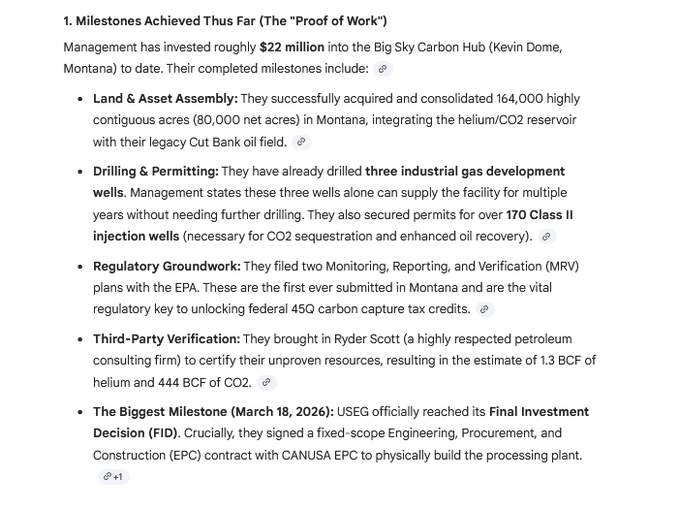
Going forward 2026 seems like it has many catalysts, and
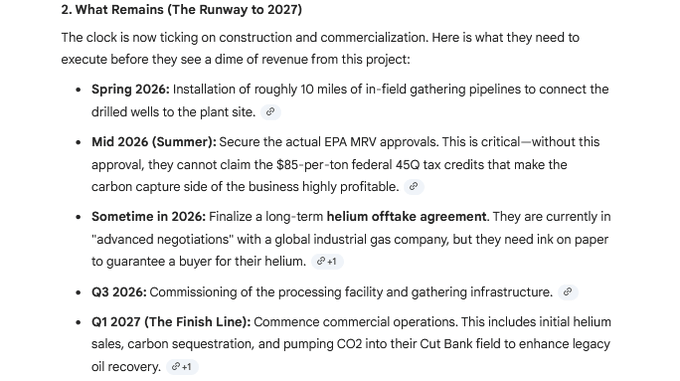
More on insider ownership.
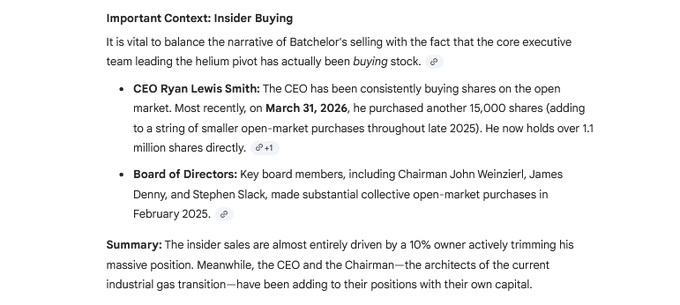
Something clearly does not add up. The chart looks like trash. And its ~50m ev against ~1b in reserves. Where is the rub: – The 1.3 Billion Cubic Feet (BCF) is unproven reserves – The is clearly some level of additional dilution required before commercialization – The most important catalyst (reaching final investment decision) occurred on the 18th. Market on the whole has been completely risk-off except very narrow pockets of retail speculation. This is clearly not a story stock or retail favorite in any way
Helium 4.0 Is Now 5.0: Why This Shortage Looks Different – and What Canada Brings to the Table
Published on May 14, 2026
Helium 4.0 Is Now 5.0: Why This Shortage Looks Different – and What Canada Brings to the Table
If you only follow helium when it shows up at a kid’s birthday party, you have missed one of the more important industrial commodity stories of the last two decades. The world is now staring at its fifth helium shortage in twenty years. Three of those five have hit in the last eight years alone. And this one, the 2026 squeeze, is structurally different from everything that came before it.
For investors, the question is not whether helium prices will spike. They already have. The question is what this particular shortage tells us about supply chains, geopolitics, and where the next decade of helium production is actually going to come from. The short version: Canada is suddenly a much more interesting part of the answer than most people realize.

A Quick History: Four Shortages, Four Different Causes
To understand why 2026 is different, you have to understand what came before. Helium has been in chronic deficit for most of the last twenty years. By some estimates, the market was in a supply deficit for eight of the years between 2006 and 2022, but each crisis had its own trigger.
Shortage 1.0, around 2006, was the warning shot. Plant outages collided with rising demand from fiber optics and a young semiconductor industry. Shortage 2.0 hit around 2012, driven by uncertainty over the future of the US Bureau of Land Management (BLM) helium auctions. Until that point, the US Federal Helium Reserve, a strategic stockpile built up during the Cold War and stored underground at the Cliffside Field near Amarillo, Texas, had effectively buffered the global market. Federal sales once accounted for roughly 35% of global production.
Then came the slow unwind. The Helium Stewardship Act of 2013 mandated that the BLM dispose of all federal helium assets. Shortage 3.0 in 2018 was driven partly by a Qatari trade embargo and partly by the acceleration of the reserve sell-off. The 4.0 shortage in 2021 stemmed from a four-month outage at a Russian plant, a fire in Kansas, and maintenance shutdowns in Qatar, all overlapping.
Through all of this, one thing held steady: the US Federal Helium Reserve, even drawn down, was still there. Until it wasn’t.
Why 2026 Is Different
On 27 June 2024, the BLM completed the sale of the Federal Helium System to Messer, a private industrial gas company. The 100-year-old federal buffer that had cushioned every previous shortage was now a private commercial asset. For the first time since 1925, the United States no longer holds a strategic helium reserve.
Then came the second shoe. In early 2026, the Ras Laffan refinery in Qatar, the world’s largest helium production complex and a major source of roughly 36% of global supply, sustained damage from regional conflict. Industry estimates put the immediate capacity loss at around 17% of Ras Laffan’s output, which translates to a ~5% hit to global supply. The Strait of Hormuz, the shipping chokepoint through which liquid helium must pass to reach Asian and European buyers, has been intermittently disrupted.
Russia was supposed to be the safety valve. Gazprom’s Amur Gas Processing Plant in Siberia was projected to add up to 25% of global helium supply at full capacity. Five years after its planned ramp-up, Amur is still running well below capacity due to a series of fires, explosions, and Western sanctions.

Why Helium Suddenly Matters More, Not Less
Helium is one of those quietly indispensable inputs that only becomes visible when it disappears. Roughly 17% of global helium is used in semiconductors, fiber optics, and controlled atmospheres. Another 15% of MRI machines in hospitals are cooled. Around 9% feeds aerospace and rocket-launch operations. And critically, there is no substitute for helium in any of these applications. You cannot cool a superconducting magnet with nitrogen. You cannot run extreme ultraviolet (EUV) lithography without helium for wafer-temperature control.
Demand is also accelerating. The AI capex super-cycle is, among other things, a helium consumption super-cycle. Every new advanced-node semiconductor fab announced by TSMC, Samsung, SK Hynix, or Intel is a multi-year increase in helium demand. Global helium demand was already projected to grow from 6.0 billion cubic feet to roughly 8.5 billion cubic feet by 2030, with import growth running at about 10% year-on-year before this latest crisis hit.
Fitch has flagged that spot helium prices could spike 50% to 200% in severe shortage scenarios. Contract prices, which are how most industrial helium actually trades, typically move more slowly, but renegotiations in 2026 are already coming in 20% to 40% higher than expiring contracts.
Where Canada Fits And Why It Matters Now
This is where the map starts to redraw itself. Canada currently supplies less than 3% of the world’s helium, but it has the fifth-largest known reserves on the planet, and crucially, it is one of the very few jurisdictions where helium is being actively developed as a standalone industry rather than as a byproduct of natural gas extraction.
Southwestern Saskatchewan has emerged as the center of this build-out. North American Helium operates the largest helium production facility in Canada and holds over a million acres of helium rights.
Royal Helium (TSXV: RHC), Avanti Helium, Helium Evolution, and First Helium are all advancing exploration and production projects across Saskatchewan and southern Alberta. The Saskatchewan government has set an explicit target of capturing 10% of global helium supply by 2030, and the Helium Developers Association of Canada is lobbying Ottawa to add helium to the federal critical minerals list, which would unlock the same tax credits that other strategic minerals already enjoy.
For investors, the thesis is straightforward. Canada offers something the current market badly needs: a politically stable, geographically proximate, scalable helium supply. Asian buyers are already exploring Canadian sourcing as a hedge against the risks posed by Qatar and Russia. The one structural gap Canada still has is the lack of a domestic liquefaction facility, so finished helium has to be sent south of the border for final processing. This is a known problem that producers and provincial governments are actively working to solve.
Downstream, the squeeze is also visible at the distributor level. As major producers prioritize their largest fab and hospital accounts, mid-market and smaller industrial buyers in Canada, research labs, electronics manufacturers, healthcare facilities, and specialty event operations are increasingly turning to independent regional suppliers to secure allocation. Independent distributors such as Welders Supply & Gases, a helium supplier serving the Greater Toronto Area, report that allocation calls are more frequent now than at any point since the 2018 shortage, with smaller buyers feeling the squeeze first.
When Does This Resolve?
Honestly, not quickly. The industry consensus on Ras Laffan repair timelines ranges from 1 to 5 years, depending on the scope of damage. Even if Qatar resumes flows within weeks, restoring the refinery to full capacity is a multi-year process. Amur’s ramp depends on factors that nobody outside the Kremlin can confidently forecast.
New supply is coming. Royal Helium’s Climax project in Saskatchewan is targeting first production in late 2026. North American Helium plans to bring an additional facility online in the second half of 2026. Exploration projects in Tanzania and South Africa are progressing. But helium exploration-to-production timelines are measured in years, not quarters.
The most realistic base case: tight supply and elevated contract prices through 2027, gradual easing through 2028-2029 as Canadian and African production scales, and a permanently higher price floor versus the pre-2024 era because the public buffer is gone for good.
The Investor Takeaway
Three things to watch from here. First, contract renegotiation terms in 2026 reporting cycles for downstream industrials, that is, where the cost pass-through will show up. Second, Canadian helium producer milestones, particularly Royal Helium’s Climax start-up, and any progress on a domestic liquefaction facility. Third, federal critical minerals policy: if Ottawa adds helium to its list, expect a meaningful re-rating of TSXV-listed helium names.
Helium 5.0 is not just another commodity shortage. It is a structural reset of how the world thinks about a small, irreplaceable molecule that quietly powers MRIs, microchips, and most of modern manufacturing. The producers who matter in the next decade are not necessarily the ones who mattered in the last one. That is the opportunity.
Peony
@peonyKingOF
This is the most interesting thing I’ve read in a bit. Trivium is not an alarmist publication and don’t recall them speaking about bottlenecks all that often. On the whole it’s really even-keeled coverage, and they do a great job of keeping things in perspective. The daily update this Sunday was on helium in China. To me it seems like China has been years ahead in securing natural resource reserves for practically everything. It turns out Helium is an exception. It also seems to be the case that (a) helium has no substitutes for critical parts of semi manufacturing, and (b) there is not a readily available way for China to fix this. In sum, I think this is early innings of what will be a rather big and long-lasting story.
The major players here are $LIN and $APD, but they helium only accounts for a tiny slice of their revenue. There are also a handful sketchy OTCs. What stands out to me is $USEG – it’s a pure play, it trades on the main exchanges, and they just raised a good amount of cash. Per Gemini “USEG’s corporate strategy explicitly outlines a focus on refining helium to “Grade 6″ (99.9999% purity). This is the exact ultra-high purity threshold required for semiconductor chip manufacturing, lab research, and advanced cooling.”
There is an obvious speculative element to $USEG given they been on the ropes for years, but I am holding regardless.
$BLLYKF also has a helium project, but its in the exploratory stage – not great for exposure to the theme – but interesting for other reasons.
U.S. Energy Corp was selected to participate in the inaugural Emerging Company Pavilion at the the 31st Annual Sohn Investment Conference on May 12, 2026 in New York City.
The Company is one of a curated group of 8–10 emerging public companies chosen for investor exposure; management will meet institutional investors to discuss helium, the Big Sky Carbon Hub in Montana, strategic partnerships, and commercialization plans.
U.S. Energy announced that CEO Ryan Smith will participate in the LD Micro Invitational XVI Conference, held May 17-19, 2026, at the Luxe Sunset Blvd Hotel in Los Angeles.
He will present at 9:00 a.m. PT on May 19 and host one-on-one investor meetings, with a live webcast available at the LD Micro events website.
US Energy Corp
@USEG_IR
Helium is not optional in quantum computing – it is structural. Superconducting qubits operate at temperatures colder than outer space, and liquid helium is the only practical coolant that gets there. There is no substitute and no workaround.
The global helium supply picture is fragile. Qatar, Russia, and Algeria – three of the largest historical sources – all carry meaningful geopolitical and operational risk right now.
Big Sky Carbon Hub in Montana is being built to produce approximately 14.4 MMcf of high-purity helium annually at Phase 1, from a resource base with a 50-plus year production life. Domestic. Contracted. Coming online Q1 2027.
11:14 PM · May 21, 2026
The Wall Street Journal
@WSJ
Exclusive: The Trump administration is awarding $2 billion in grants to nine quantum-computing firms including IBM in deals that include government stakes
From wsj.com
1:40 PM · May 21, 2026
“The 2026 helium crisis is real. Nearly one‑third of global supply is offline after strikes shut down Qatar’s Ras Laffan facility, and the Strait of Hormuz is effectively closed. Spot prices are up 40–100%, labs and fabs are rationing, and repairs are expected to take 3–5 years. This is the most severe helium squeeze yet.”
USEG_IR
Every chip starts as a silicon crystal grown in a helium atmosphere. Every fiber optic cable is drawn in one too. The CHIPS Act is adding domestic fab capacity fast — and each new facility needs helium. Supply is not keeping up. US Energy is building domestic contracted helium production in Montana targeting Q1 2027.
USEG_IR
Quantum computers operate near absolute zero – liquid helium is the only coolant that gets there. The U.S. just committed $2 billion to domestic quantum computing. Every dollar of that investment needs a reliable helium supply chain. Big Sky Carbon Hub. Montana. Q1 2027.
U.S. Energy Corp. (NASDAQ: USEG) will rebrand as Big Sky Industrial Inc. (NASDAQ: BSIN) effective June 8, 2026. The change aligns with its focus on helium production, carbon management, and low-decline oil at the Big Sky Carbon Hub in Montana’s Kevin Dome region.
No shareholder action is required; share count, par value, CUSIP, and other common stock terms remain unchanged.
BSIN_IR
Follow
$BSIN There are 40,000+ MRI machines worldwide. Every one runs on liquid helium. No helium means no MRI imaging — there is no alternative coolant. Hospital systems quietly compete for every cubic meter produced. Full Helium Series on our profile.
https://www.youtube.com/watch?v=gHd9lenQNh0
Tom Kerr, CFA: Hello, everyone. My name is Tom Kerr, Senior Equity Analyst at Zacks Small Cap Research, and welcome to another episode of our CEO Chat program. Today, we have the CEO of Big Sky Industrial, Ryan Smith. Big Sky Industrial (NASDAQ: BSIN) is an integrated energy company transitioning from a legacy oil and gas company to a newer industrial gas, energy, and carbon management platform. The company’s primary operations are based in northern Montana. The headquarters are in Houston, Texas. The company was formerly known as US Energy but instigated a rebranding initiative last week to change the name, and the new ticker is BSIN. Our latest update report has a price target of $3 per share. Welcome, Ryan.
Ryan Smith: Hey Tom, good to see you, and thanks for having me.
TK: Let’s get started with the rebranding, of course. You’ve been known as US Energy for quite some time, and the change to Big Sky Industrial. Give us a little background and what led to that name change.
RS: Yeah, for sure. The company’s been public for a very long time. We traded as US Energy Corp. for decades as a conventional oil and gas producer. Over the last couple of years, we have fundamentally transformed that business. We’ve assembled an asset base in Montana that does something very unusual. It produces helium, which is a federally designated critical mineral, alongside a very high-quality stream of CO2 that we capture and manage. So today we’re really three businesses in one. We’re helium production, carbon management, and conventional oil. And as that transformation took hold, the old name simply didn’t describe us anymore. We’re not a traditional EMP company. We’re a helium, industrial gas, and carbon management company. So, on June the eighth, we completed the rebrand to Big Sky Industrial, and our NASDAQ ticker changed from USEG to BSIN, but we’re the same company, same shares, same team, just a public identity that finally matches the strategy.
TK: That makes sense. Well, let’s get into the revenue streams, or what you call the Big Sky Carbon Hub in northern Montana. As I think you just mentioned, there are three potential revenue sources. Let’s look at each one and see how they’re integrated. The first one is helium, of course. What is the assay base for that, and how do you get that out of the ground?
RS: Yeah, exactly right. We have three revenue streams coming from this. As you mentioned, our flagship asset is the Big Sky Carbon Hub in northern Montana. It sits on top of a large geologic structure called the Kevin Dome, which is one of the largest features of its kind in the United States. And what really makes it unique is the gas stream itself. The gas that comes out is a non-hydrocarbon gas stream with significant amounts of helium. And just as a note, most of the world’s helium is produced as a tiny byproduct of large natural gas fields, which kind of further bifurcates the uniqueness of the helium that we have on this asset base. The helium concentration in the gas stream is highly economic by industry standards, and on a volume basis, in our initial phase one development, we have about 1.3 billion cubic feet of helium in the resource. The production method is completely conventional. We already have three producing wells delivering stable, low-decline gas, and those wells alone are expected to supply our initial processing plant for years without drilling anything new. So, we’re not doing anything exotic to get it out of the ground. The innovation is really what we do with the gas once it’s at the surface, and that’s where the processing plant comes in.
TK: Got it. We’ll get into the processing plant and where that helium goes in a few minutes. Let’s just take the second and third revenue streams. The second is carbon capture, which is interesting, where you’re going to capture and store CO2. Explain how that works and how you get paid from that, from the federal government, I believe.
RS: Yeah, so when we process that gas to pull the helium out, we’re left with a very large, very high-quality amount of CO2. And instead of venting it into the atmosphere, we capture it and put it permanently and safely underground in deep geologic formations. Simplistically, that’s carbon sequestration. The way we get paid for it is a federal tax credit called Section 45Q. Under 45Q, the government partners with operators and owners of the necessary infrastructure and effectively pays roughly $85 per metric ton of CO2 that we capture, utilize, and permanently store.
In phase one, we’re moving some pretty significant volumes and expect to utilize and sequester about 125,000 metric tons a year, which, just for understanding, that’s probably the equivalent of about 25,000 cars taken off the road. At those volumes, it adds up to about an estimated $130 million of 45Q value over the course of phase one. What we like about that is, you know, obvious comments, policy supported, commodity independent. Our carbon management business doesn’t care what oil or helium prices do. It’s a predictable, federally backed cash flow stream tied simply to how much CO2 we capture and put away. To claim those credits, you need an EPA-approved monitoring plan called an MRV, and that’s a very big near-term milestone that we’re working through.
TK: Are the MRVs expected in 2026 or any time frame on that?
RS: They are. They are expected through 2026. We’re hoping that they’re granted over the summer, but over the course of 2026, we’re very confident that we’ll get the approvals that we need.
TK: Got it. And the third revenue stream is oil. Despite the name change, you’re still going to be in the oil business a little bit because of the unique asset base. And what you’re doing there in Montana is enhanced oil recovery using CO2. I know that’s a big buzzword, could you explain what CO2-enhanced oil recovery is?
RS: That’s the third stream, and it’s a really elegant piece of the model outside of just traditional oil and gas production. Enhanced oil recovery is a multi-decade-old proven technique. When an older oil field is giving up all the easy oil, you can inject CO2 down into the reservoir. Simplistically, the CO2 mixes with the trapped oil, frees it up, and pushes additional barrels to the surface that you otherwise could never recover. Why is it so powerful for us, specifically? Most companies, a lot of companies, do CO2 EOR and have to go out and buy the CO2 and source the CO2. That’s a major cost.
We don’t have to do that. We capture our own CO2 at the Big Sky Hub as part of the helium processing. We own the nearby oil field called Cut Bank that has a very long production history. It contains more than 170 permitted injection wells that are already in place. So, we get paid the 45Q credit to put the CO2 into the ground, and then we sell the incremental oil that comes out the other side. It’s, again, another case on this asset where the same molecule is earning money twice regarding the oil asset, with tens of millions of barrels of recovery upside over the life and development of the field.
TK: Now that’s great. That’s a very diversified revenue stream. You don’t see that that often, to have a company of your size with three sorts of dedicated and unique revenue streams. Back to helium for a second, you recently announced that you had entered into an offtake agreement. An offtake agreement is more of a selling agreement for customers that don’t know what that is, but can you explain what the offtake agreement is and what it means for you, as it pertains to the helium business?
RS: Yeah, it’s hugely important. You described it well. An offtake agreement is essentially a pre-arranged buyer for our helium production. We signed a five-year agreement to sell our helium to a global investment-grade industrial gas company, one of the leading helium distributors in the world, and exactly the kind of counterparty that you would want to have on a project like this, and the key feature is that it’s a hundred percent take or pay. That means the buyer is contractually obligated to pay for the helium, whether they take physical delivery or not.
So, when you think about what that does for us, before we’ve produced a single molecule commercially, we already have a long-term contracted investment-grade buyer for essentially all of our helium output. That removes market risk, it removes credit risk, and it turns this into a development project, into a financeable, predictable, cash-flowing business. For a company our size, that kind of validation from a major global player, in my opinion, is worth nearly as much as the cash flow itself.
TK: Got it. Interesting. Let’s talk about infrastructure for a second. Although the wells are there, you’re still building out a lot of infrastructure, and let’s take it in two parts. One is the processing plant, and the other is sort of the infrastructure to get the oil and helium where it wants to go. Let’s take the first one, the processing plant. That’s going to, what is it, liquefy helium, process CO2? Where does that stand, and what does it do exactly?
RS: Great question. The plant is the heart of the whole operation. It’s what purifies the helium and captures and liquefies the CO2. The big de-risking news is that we’ve already reached what’s called a final investment decision on the processing plant, and we’ve signed a fixed scope engineering and construction contract with our EPC partner, which is a leading EPC provider for these types of industrial gas facilities, both in the United States and in Canada. So, it’s no longer just a concept on paper. Capital is being spent today, long lead equipment items are on order, and our contractor and our employees are mobilized to get this put together every single day.
On the ground in Montana, as you mentioned, the infield gathering pipelines go in this year. It’s a very simple gathering system that we’re laying. Relative to gathering systems, it’s very cheap. Those gathering numbers are built into our public given CapEx. And we’re targeting commissioning ahead of first commercial operations for everything in the first quarter of 2027. So right now, where we sit, we’re roughly nine months out from turning the whole platform on. Helium sales, carbon management, CO2, EOR, all coming online together.
TK: Got it, and then the other part of the infrastructure is getting the helium and oil where it’s supposed to go. For those who don’t know where the Big Sky Carbon Hub is located, it’s in a very northern rural part of Montana, almost at the Canadian border. How does the helium get from the processing plant to the customer? And number two, how does the oil get from the oil wells to the customer?
RS: Fair question, because northern Montana sounds remote, but in the industrial world, where we’re actually very well positioned logistically, the offtake structure makes it even simpler. Under our sales agreement, the buyer takes title to the helium right at our plant gate and handles all the downstream transportation and distribution themselves. That heavy logistics burden sits with a global gas company that does this every single day, all over the world, and not just with us. That said, the location is genuinely good. We have major rail access through the Port of Northern Montana at Shelby. We sit near interstate trucking on both I-15 and I-90. Helium ships in specialized containers, and from our hub, it can move by rail or truck to wherever our customers need it, so we’re not building in a logistics desert. The oil is the easiest piece because it’s a conventional, established operation. The Cut Bank field has been producing for a very long time and already has the infrastructure in place. The gathering, the trucking that move our oil to market – our market up there is a very large refinery system that’s right outside of Billings, Montana – the same way it has for many years, so there’s no new system to build there.
TK: Then the CO2 doesn’t really need to go anywhere. It gets sequestered back in the ground or sent to the oil wells themselves, so that’s kind of a closed-loop system there.
RS: Correct.
TK: All right. Let’s talk about some financials for a second. In terms of liquidity, recently, what is cash, debt, and total available liquidity, and then part two, does that fully fund the infrastructure build-out until revenue 2027?
RS: This is the question that every investor rightly asks. I’ll be direct with it. Phase one, building the entire platform and getting to first revenue, is fully funded. We’ve already deployed roughly – again, some of these numbers move within quarters and stuff like that, so I’ll give general numbers that are guided from what we’ve talked about in the market already – but we’ve deployed roughly $35 million of our own money into the project. The remaining capital to complete infrastructure construction at this point is on the order of another $20 million or so remaining until the plant is online. That remaining amount is fully covered between cash on hand from our March equity raise and our existing debt facility, which we expanded in April.
Importantly, just talking about the capstack, we’ve formally suspended our equity line of credit, which was a very good instrument for us earlier in the year. That being said, we’re not planning to issue dilutive equity to get phase one across the finish line. Additionally, we’ve hedged a meaningful portion of our oil production to lock in cash flow through the construction window with the rise in prices that you’ve seen over the last few months. So, to put it plainly, the path to first revenue is fully funded with no financing contingencies. I personally believe this transforms the question from whether we can build it, to what it’s worth once it’s up and running.
TK: Got it. When it’s up and running, that’s going to be a 2027 event. Hopefully, all three revenue streams will come online. You’ve talked in investor presentations and about what this business could look like, say, three years, five years from now. I know you don’t give guidance at this point, but generally speaking, any comments on how big this could be looking out two, three, or four years?
RS: I’ll answer this carefully for the caveat that we’re a public company, so we have to be disciplined about forward-looking statements. I want to be clear that this is illustrative modeling and not formal guidance. With that being said, looking out over the next five years or so, I think the base of our asset demands, in a good way, and the economics demand, in a good way, scaling this asset. The size of the resource, the end user markets, all are up and to the right, and you want to expand as much as reasonably possible. I’ll use a 2030 date. By 2030, we expect to have both processing plants – our initial phase one, which we’ve already talked about, and further, larger development, which we’ll refer to as phase two, which we expect to be roughly two and a half to three times the size of phase one, funded largely from our own operating cash flow rather than dilution – both of those phases in operation.
With that full platform running, our internal models point to a $40 to $50 million range of EBITDA. That is two-thirds consisting of helium and carbon management revenues, with the remaining being oil and gas revenues, and a business that continues to compound and scale from there. The reason that we have conviction in the shape of that financial profile, even if any single number moves around, is really the structure beneath it. Three diversified streams: helium under a take-or-pay contract, carbon revenue federally supported, we’ll continue to hedge out oil production to lock in that predictable cash flow, so it’s not just a one-commodity bet. It’s a diversified, largely contracted cash-generative platform.
TK: That’s great. You just kind of mentioned this, but I think it’s a good story. Of those three revenue streams, the majority of them, two-thirds, are not subject to price volatility. You said the oil you might hedge, so there’s still some price volatility, but for the carbon management with the offtake agreement, there’s no end price volatility. Any other things we might have missed, important points, closing comments?
RS: First of all, thank you for having me. I will give one framing thought: I think Big Sky Industrial is one of the more unique stories in the small-cap space right now. We sit at the intersection of three themes that investors and the United States government could care a lot about: critical minerals and domestic supply chain security through helium, carbon management, and energy. We have one asset, we have one molecule that turns into three independent revenue streams, two of which are either contracted with an investment-grade counterparty or federally supported by the United States government.
We’ve taken a lot of the major risks off the table. We’ve reached final investment decision, we’ve signed our offtake agreement, and phase one is fully funded. So right now, it’s really about execution into first production in 2027. We’re very excited about what’s ahead. We encourage everybody to follow along. Our new ticker is BSIN, and there’s a lot more in our filings and on our website. I appreciate it, Tom, for having me and everybody for listening in today.
TK: Great. Thanks for your time. To read all of our reports, investors can go to SCR.Zacks.com as well as our social media channels. You can also go directly to the company’s website at BigSkyindustrialInc.com. That concludes our CEO chat, and I really appreciate you being here.
RS: Thanks for having me, Tom.
BSIN_IR
See the recent interview with CEO Ryan Smith as he walks through our project in Montana, where domestic helium production, §45Q carbon sequestration, and CO₂-EOR crude all come off one integrated asset. Phase 1 is fully funded and doesn’t need dilution to reach first production, which we’re targeting for Q1 2027, on a resource base with more than 50 years of life.
investorshub.advfn.com/mark…
Jul 15, 2026 10:10 PM
———————
Scrutinizer91
Jul 15, 2026 11:55 PM
@BSIN_IR I think I’m developing a bit more clarity on the potential Helium and 45Q revenue stream implications. But the one thing I would enjoy more amplifacation upon is the reasonable uplift expectations from their oil properties. When I performed an AI query, it stated “hundreds to thousands” of increased BOPD from CO2 injectioons..
Have they conducted any testing using a different CO2 sources in order ascertain uplift expections?
Maybe focus on the actual extent of injectable oil well properties that the company controls and provide some more visibility on potential revenue increasess from the legacy oil revenues.
Doubling oil production is one thing, but if we could potentially see a long-term increase in the multiple hundreds of barrels per day, would be quite another when it comes to company valuation analysis.
==============
https://investorshub.advfn.com/market-news/article/31911/big-sky-industrialone-gas-stream-three-business
Big Sky Industrial:One Gas Stream, Three Business
Ricki Lee
Ricki:
Helium is often overlooked by investors, but it’s a critical industrial gas with growing demand across everything from semiconductor manufacturing to medical imaging and even aerospace. So, could one of the market’s most overlooked helium companies also be one of its most undervalued?
I am Ricki Lee, and I’m joined today on the Capital Compass by Big Sky Industrial (NASDAQ:BSIN), formerly U.S. Energy Corp. Following its recent corporate rebrand as the company sharpens its focus on industrial gases, particularly helium. Backed by a growing resource base, a strong balance sheet, and a long-term helium offtake agreement with an investment-grade customer, Big Sky is positioning itself as a differentiated player in a market where reliable North American helium supply is becoming increasingly important.
Joining me today to discuss the company’s strategy, financial strength, and why management believes the market may be undervaluing the story is Ryan Smith, President and CEO of Big Sky Industrial. Ryan, it’s great to have you back with us.
This article is disseminated in partnership with Big Sky Industrial Inc. It is intended to inform investors and should not be taken as a recommendation or financial advice.
Ryan:
Hey, thanks, Ricki. Great to be with you. It’s an exciting time for the company, so I appreciate the chance to walk through the audience through the story.
Ricki:
And I appreciate you taking the time to take us through it. So let’s start with the rebrand. The company recently transitioned from U.S. Energy Corp to Big Sky Industrial. What does that change represent, and why is now the right time to reposition the business around industrial gases and helium?
Ryan:
Yeah, I mean, the name change really reflects who we’ve become as a company over the last few months. Big Sky, formerly known as U.S. Energy was a legacy oil and gas producer for a very long time, multiple decades. And over the last two years, we’ve built something fundamentally different, which is an integrated industrial gas and, and carbon management platform that is anchored by our Big Sky Carbon hub in the state of Montana. Helium is a federally designated critical mineral and demand keeps climbing across semiconductors, aerospace, military defense and healthcare and all the really big industries that are projected to grow exponentially going forward.
And the reason now is the right moment for all of this is really simple, that we’re at a point in our project where it’s not really aspirational anymore. We’ve reached a final investment decision and made great progress on the last phase of our necessary infrastructure. We’ve fully funded this phase of our development and we’ve locked in a long-term customer. So Big Sky Industrial is a name that finally matches the business that we’ve built, and just as importantly, a platform that we can scale for years to come.
Ricki:
And Ryan, one of the themes highlighted is that Big Sky may be undervalued relative to its position in the helium sector. What do you think investors are missing about the company today?
Ryan:
I do think we’re undervalued. I think the market is still looking at us through an old lens, which is the legacy oil and gas multiple when the business underneath it has really changed completely. What I don’t think is fully appreciated is that we have three independent, durable revenue streams sitting on a single integrated asset.
First, we have helium, which is very topical right now in the global markets. It’s a critical mineral, long-term take-or-pay contract already behind it.
Secondly, we have our carbon management business, the Section 45Q tax credits, which is a bipartisan federal incentive that is written into law for permanently sequestering CO2.
And third, still oil. We put that same captured CO2 to work recovering increased oil from a nearby legacy oil field that we own a hundred percent outright. And what I also think gets very much overlooked is everything I’ve described is really just phase one.
We’ve assembled an extremely large platform in Montana with a resource life of more than fifty plus years, this first phase is really just the first increment of a much bigger asset base, and most of that upside simply isn’t showing up in the stock yet. So, my job here is straightforward, to continue executing our project and let all of these catalysts speak for themselves.
Ricki:
You’ve also reported strong financial results and recently secured a five-year helium offtake agreement with an investment-grade customer. How do those milestones strengthen the business and reduce risk as you continue to grow?
Ryan:
Yeah, I mean, that agreement that you just mentioned, it’s foundational. It’s extremely important. Before we produce a single molecule, we already know who’s buying it and at what price they’re buying it at. The agreement is a five-year take-or-pay contract with an investment-grade global industrial gas company, one of the largest helium buyers in the entire world. And, and take-or-pay means that they’re obligated to pay for the volumes whether they take them or not. So it’s contracted cashflow, not hope for cashflow.
And the pricing is fixed and all in at the plant gate. It escalates annually with inflation, and the customer carries the downstream transportation and purification costs. It’s also, in my opinion a very strong third-party validation of everything that we’re doing. A highly sophisticated global buyer did real diligence and committed to buying all of the volumes from phase one of our project, which it also still leaves meaningful future volumes uncontracted for us to sell into what I believe is universally forecasted into a very tight market. For a company like us that’s moving rapidly towards commercial operations, that combination takes an enormous amount of risk off the table and makes the whole project underwriteable and bankable.
Ricki:
So Ryan, beyond helium, Big Sky is building out a carbon management business, capturing, transporting, and using CO2 anchored by the Big Sky Carbon Hub. How does carbon management fit alongside helium in the company’s strategy, and what makes it a durable revenue-generating part of the business?
Ryan:
Yeah, I mean, carbon management is really the engine that ties the whole asset and the whole ecosystem together because the captured CO2 itself is a very valuable resource. Our entire helium extraction and processing activities create a large volume of natural CO2 right alongside the helium process, and we capture 100% of that, and we monetize it in two different ways.
First, we permanently sequester CO2 that we capture underground and earn Section 45Q tax credits, a federal incentive with very strong bipartisan support that’s well-established and written into current law.
And second, we take that same CO2 stream and inject it into a nearby legacy oil field to recover crude that otherwise couldn’t be produced. And that crude oil is our third revenue stream. Very importantly, in that process, the CO2 stays locked in the reservoirs, so it’s never vented out and into the atmosphere.
What makes this all durable is that it’s long dated cash flow on infrastructure that we own and control with decades of production ahead of us. So we’re not choosing between helium or carbon or oil. It’s one integrated hub producing three streams of revenue with plenty of room to grow. And we think it’s both good stewardship of our investors’ capital and the environment as well.
Ricki:
And so finally, Ryan, looking ahead over the next twelve months, what are the key milestones investors should be watching as Big Sky continues executing on its strategy?
Ryan:
Yeah, a few very clear markers. The most important near-term catalyst is EPA approval of our MRV plans the monitoring and reporting and verification framework that unlocks the 45Q carbon credits. We expect that during 2026 hopefully more on the front end of that timeline than the back end, though it is subject to the agency’s review process, which unfortunately I do not control.
But beyond that, we’re executing on the phase one build under our fixed scope construction contract and moving towards first commercial production targeted for the first quarter of 2027. I think investors should also watch the enhanced oil recovery side because that’s, as I mentioned, the third stream of cash flow that’s, that’s layered on top of the very same asset.
And because phase one is funded we can convert construction into commissioning and ultimately into cash flow without needing to raise dilutive capital to get there. And as that all comes together, we’ll be advancing planning for future expansion because what we’ve discussed today, phase one really only taps a fraction of the resource, and the runway to scale from here is very substantial. So there’s very clear and tangible upcoming milestones that turn the story from a plan into a growing highly economic and scalable platform as we move forward into the years ahead.
Ricki:
Well, Ryan, thank you so much for joining us and walking us through the Big Sky Industrial story.
Ryan:
Thanks, Ricki. We’re excited about what we’re doing, always happy to come on and talk about it.
Ricki:
Well, for more information, you can visit bigskyindustrialinc.com. I’m Ricki Lee, and this has been The Capital Compass. Thank you for watching, and I’ll see you again next time.
July 15 2026 2:30AM
Nikolas Alvarez Naranjo
@NikolasAlvarezN
The Hidden Helium Boom: How Big Sky Industrial Is Powering Domestic Helium Supply for AI & Quantum.
Demand for helium will grow exponentially, much like LNG did during its boom years. Big Sky Industrial Inc. ($BSIN) saw this years ago. The U.S. has clear opportunity to become a leading global supplier in both production and exports. Recent geopolitical disruptions — particularly those affecting supply routes tied to the Strait of Hormuz — have removed roughly one-third of global helium supply, primarily from Qatar. This has created immediate shortages that are already impacting high-tech industries and underscores why reliable domestic helium production is now a strategic priority.
A Barron’s interview last month with Cantor Fitzgerald analyst Troy Jensen is essential reading for anyone following quantum computing. With 28 years of experience, Jensen started as a skeptic but, after two years of deep research, now believes the sector is on the cusp of commercialization — likely in hybrid form alongside classical computers within the next one to two years. He covers superconducting, trapped-ion, neutral-atom, and photonic approaches.
The detail with the clearest supply-chain implication: superconducting qubits, used by companies such as IBM and Google, require dilution refrigerators cooled to near absolute zero. There is no practical substitute coolant that reaches those temperatures at commercial scale — and those systems depend on a steady supply of liquid helium.
McKinsey projects quantum computing could generate $43–71 billion in revenue by 2035. Boston Consulting Group estimates $450–850 billion in economic value creation by 2040. The physical foundation of the superconducting segment starts with helium.
Semiconductors represent an even larger and more immediate demand driver. Thanks to the CHIPS Act, U.S. chip manufacturing is expanding rapidly. Helium is irreplaceable in semiconductor fabrication — used for cooling, purging, and creating inert atmospheres during advanced node production. Analysts project U.S. semiconductor helium demand could quadruple by 2035 as new fabs ramp up. AI, high-volume manufacturing, and leading-edge processes are accelerating this need.
Yet the U.S. no longer has the Federal Helium Reserve as a market buffer — it was fully divested in 2024. With global supply under pressure, domestic projects are stepping up to fill the gap.
Big Sky Industrial Inc. ($BSIN, formerly U.S. Energy Corp.) is actively building one of the most significant new domestic helium resources at the Big Sky Carbon Hub in Montana’s Kevin Dome region. The project holds substantial helium resources with a potential production life exceeding 50 years. In Q1 2026 the company reached Final Investment Decision (FID), completed its Phase 1 capital stack, and signed a five-year, 100% take-or-pay offtake agreement with an investment-grade global industrial gas company. Construction is now underway, with first helium sales and carbon management operations targeted for Q1 2027.
The project is particularly attractive because it generates multiple revenue streams from the same asset: helium production, CO₂ carbon management (leveraging federal 45Q tax credits), and enhanced oil recovery. This integrated model reduces risk and enhances returns while delivering critical domestic helium supply exactly when high-tech industries need it most.
Another key player advancing domestic and near-term supply is ASP Isotopes ($ASPI). The company completed its acquisition of Renergen and the Virginia Gas Project in South Africa in January 2026. Helium concentrations there are significantly above global averages. ASPI is rapidly expanding the facility to produce high-purity liquid helium targeted at semiconductors, quantum computing, and other high-tech uses. Phase 1 commercial operations are on track for the third quarter of 2026, backed by the project’s first take-or-pay contract. A much larger Phase 2 expansion is also in planning.
The quantum computing market is being valued in the trillions by some long-term forecasts. Yet the helium supply chain that makes superconducting systems physically possible has received far less investor attention — even though it sits at the very foundation of the technology.
Domestic helium production isn’t just an investment opportunity — it is becoming a strategic necessity for America’s leadership in semiconductors, AI, quantum computing, and advanced manufacturing.
4:24 AM · Jul 13, 2026
Return of Qatar and UAE LNG volumes ‘delayed to October’
By Dominic Ellis, July 18 2026
The Independent Commodity and Intelligence Service (ICIS) has delayed its forecasts on the return of Qatar and UAE liquefied natural gas to market to October.
Before the latest escalation, it had forecasted Qatari output returning in August, ahead of maximum output in September.
The readjustments in expected LNG supplies for August and September will have major implications for the global economy and energy sector.
Around 5 to 6 million tonnes of LNG output will be lost for every extra month that Qatar and the UAE are offline, according to ICIS. With the downward revision of Qatari LNG supply, it estimates European LNG imports to shrink slightly by -3.2% year-on-year, but anticipates a strong rebound in 2027 and 2028.
©ICIS
“Alternative new sources of supply have also been slow to build up this year,” it notes.
“The biggest expected new supply this year was Qatar’s own expansion, which is now delayed into H2 2027 or beyond. The next biggest addition was the US Golden Pass plant, which had been hoped to bring on one or two 6 mtpa trains this year and later a third, to reach 18 mtpa capacity. So far this year Golden Pass has only loaded four cargoes, one each month in April, May, June and July, compared with around seven per month if the first 6 mtpa train was operating full.”
With Europe’s gas storage remaining low, the global LNG tightness fuels a sense of urgency for storage refilling and poses concerns for the winter ahead – but ICIS projections indicate European gas storage can still reach November targets even under a longer closure of the Strait of Hormuz.
Though it comes at a price. ICIS modelling suggests TTF would need to average around €54/MWh during the storage-filling season to attract sufficient LNG to Europe and sustain storage injections.
“Under both our base case and cold winter scenarios, European gas storage reaches around 80% fullness by 1 December 2026. While this remains consistent with the lower end of the EU storage regulation and provides a solid proxy for security of supply, the market must increasingly pay for this outcome through higher gas prices,” it adds.
ICIS’ total 2026 LNG supply forecast is now around 431 million tonnes, down from 441 million tonnes previously.
Separate analysis from S&P Global forecasts US LNG export capacity is projected to double over the next five years, making LNG the country’s second-largest net export industry.
The helium industry is also dependent on the resumption of Ras Laffan operations, with Qatar accounting for around a third of global helium supply.
China plans to adjust export controls for helium based on changes in domestic and international supply and demand, according to a Ministry of Commerce spokesperson.
China imports over 85% of its helium, primarily from Qatar, which has faced supply disruptions due to geopolitical tensions.
On July 10, 2026, China enacted a temporary ban on helium exports. This decision was made to protect domestic supply under the country’s Foreign Trade Law. The ban does not have a specified end date.
Reasons for the Ban
Domestic Supply Protection: The primary goal is to ensure that critical helium supplies remain available for essential industries.
Global Supply Tightening: The ban comes amid a global shortage of helium, which is vital for sectors like semiconductors, medical equipment, and aerospace.
This export ban reflects China’s strategy to secure its domestic helium supply amid increasing global competition and supply chain vulnerabilities.
—————
Financial Times
@FT
·
21h
Chinese helium ban threatens supplies to Europe
——————-
Big Sky Industrial Inc
@BSIN_IR
·
18h
“China isn’t a source; it’s a conduit”, meaning the halt “pinches a re-export valve Europe had been leaning on” – FT
Big Sky Carbon Hub in Montana is coming online in 1Q27 and will help insulate critical industries in the United States from supply shocks outside our boarders.
https://www.bbc.com/future/article/20250331-why-helium-shortages-are-worrying-the-world
2026 Helium Shortage: Why Recovery Will Take Years, Not Weeks
Learn why recovery from the helium shortage will take years, even if the Strait of Hormuz reopens and stays open.
By Lawrence Haynes
8 min. readView original
Roughly one-third of global helium supply is offline after March 2026 missile and drone strikes destroyed key production trains at Qatar’s Ras Laffan facility.1 Even when the situation in the Strait of Hormuz fully resolves, the supply damage will take years to repair.
U.S. distributors are rationing supply and spot prices have skyrocketed.
What’s Happening with Helium Currently?
Helium distributors across the U.S. market are rationing supply, prioritizing healthcare customers, and adding surcharges on whatever volumes they can deliver. Several have invoked force majeure on existing contracts, a clause that releases suppliers from their delivery obligations during extraordinary events outside their control.
Airgas, a major industrial gas supplier, declared force majeure on helium shipments effective March 17, 2026. The company has been prioritizing healthcare customers, anticipates only providing up to 50% of normal monthly allocations to some clients, and imposed a $13.50 per hundred cubic feet surcharge above contracted prices.2
Helium spot prices have surged 40% to 100% since the crisis began,3 but buyers are gladly paying the premium when they can find supply at all.
If you’re calling around looking for spot volumes outside of an existing contract, you’re competing with semiconductor foundries, research universities, and hospital procurement teams for the same constrained supply.
What Triggered the 2026 Helium Crisis?
The helium crisis traces back to February 28, 2026, when joint U.S.-Israeli strikes on Iran triggered a regional war that has rocked global energy markets. Iran responded by effectively closing the Strait of Hormuz, the 21-mile-wide waterway between Oman and Iran that handles about a fifth of the world’s oil and LNG supplies, including nearly all of Qatar’s LNG exports.4
But the damage didn’t stop at the strait. Iranian missile strikes on March 18 and 19, 2026 damaged the Pearl GTL facility at Qatar’s Ras Laffan Industrial City, a gas-to-liquids plant where helium is produced as a byproduct. The outage is expected to take roughly 310 million cubic feet of annual helium production offline.5
A ceasefire agreement was reached between the U.S. and Iran in April, but Iran again closed the strait due to issues with the U.S.’s blockade.6
How Long Will the Helium Shortage Last?
The helium shortage is expected to last up to five years, with prices likely to stay elevated for up to three years.
The Strait of Hormuz reopening—and staying open—won’t fix the problem. In a March 19, 2026 statement, QatarEnergy CEO Saad al-Kaabi said that the damage to the LNG facilities will take between three and five years to repair.5
More money won’t speed things up. Replacement gas turbines for refrigeration compressors face 2 to 4 year global delivery delays. Only three manufacturers worldwide produce the required equipment and their order books were already stretched entering 2026.7
Recovery within Ras Laffan is uneven. The north site, with 41 million tonnes per annum (MTPA) of capacity, could restart within a month of a confirmed restart decision. The south site took the direct hits and won’t restart before the end of summer 2026 at the earliest, with capacity dropping from 36 MTPA to 24 MTPA, a loss that won’t be recovered for years.8
Which Countries Produce the World’s Helium?
Helium, which cannot be manufactured, is recovered as a byproduct of natural gas processing in a small number of countries, with the U.S. and Qatar alone producing more than 75% of global supply.
Extraction is only economically viable in gas fields with high enough helium concentrations.9 That’s why production is so geographically concentrated.
Total global production in 2025 was approximately 190 million cubic meters, distributed across a small number of countries. Russia’s share, however, is effectively unavailable to Western markets, as the EU and U.S. have banned helium imports from Russia.10
Helium suppliers in the world
LNG Plant Code
Country
State
/ Territory
LNG Plant Name
Operator
Annual
Production (million cubic meters)
Percent of Global Supply
Important Notes
1.
United States
Texas, Oklahoma, Kansas
Hugoton Natural Gas Field
Messer / Various Operators
34
20%
100+ years of production; declining output
2.
United States
Wyoming
Shute Creek Helium Plant
ExxonMobil
40
20%
Largest U.S. helium facility; 80 years of reserves remaining
3.
Canada
Saskatchewan
Battle Creek Plant
North American Helium
1.4
0.8%
Largest helium plant in Canada; 85% of Canadian output
4.
Algeria
Bethioua, Skikda
Arzew & Skikda Plants
Sonatrach / Air Products / Linde
34
6%
Capacity of 50M m³ but runs well below due to feedstock issues
5.
Poland
Odolanów
KRIO Odolanów Facility
PGNiG / Orlen
2.7
1.4%
One of only two liquid helium plants in Europe
6.
Qatar
Ad-Daẖirah
Ras Laffan LNG Plant
QatarEnergy
63
33.2% (OFFLINE)
Damaged by Iranian strikes March 2026; force majeure declared
7.
South Africa
Virginia
Virginia Gas Project
ASP Isotopes / Renergen
0.7
0.4%
Phase 1 commissioning; Phase 2 targets ~9-10M m³/yr
8.
China
Huanglong
The Huanglong Gas Field
PetroChina / Various Operators
1.5
0.5%
85% imported; Changqing complex is largest domestic source
9.
China
Qingyang
The Qingyang Gas Field
PetroChina / Various Operators
1.5
0.5%
85% imported; Changqing complex is largest domestic source
10.
China
Zhenging
Zhenging Plant
PetroChina / Various Operators
1.5
0.5%
85% imported; Changqing complex is largest domestic source
11.
Russia
Amur
Amur Gas Processing Plant
Gazprom
40
9.5% (sanctioned, unavailable to Western markets)
EU/US ban on Russian helium imports; 2 of 3 units online
Between 2021 and 2024, Canada supplied 47% of U.S. helium imports, Qatar supplied 28%, Algeria supplied 10%, China supplied 5%, and other sources made up the remaining 10%.10
On the domestic side, two facilities matter most for U.S. buyers right now: ExxonMobil’s LaBarge plant in Wyoming and Messer’s operations in Texas. Together they represent the bulk of supply that isn’t crossing an ocean.
ExxonMobil’s LaBarge facility provides around 20% of the world’s helium. At current extraction rates, the reserves are estimated to last another 80 years.11
Messer, which supplies helium to WestAir, holds the other major domestic position. In June 2024, the industrial gas firm closed on its $460 million acquisition of the Federal Helium System from the Bureau of Land Management.12 Ahead of the sale, the asset supplied 20% of domestic helium demand and 9% of global demand.13
Why Can’t Helium Be Stockpiled Like Oil or Gas?
Helium atoms are too small and too volatile to store at scale once extracted, so the global supply chain depends on continuous production and rapid delivery rather than reserves.
Once helium is recovered from natural gas, it has to be purified to extremely high levels and liquefied at temperatures near absolute zero. From there it’s transported in specialized 11,000-gallon cryogenic containers loaded onto trucks and craned onto cargo ships.14
The numbers on storage are unforgiving. Helium leaks out of even the best cryogenic containers at a rate of 0.1 to 1 percent per month under ideal conditions, because helium atoms are too small for any gasket or fitting to fully contain. Those containers also have to maintain temperatures of -269°C (-452°F) just to keep the helium liquid (helium has the lowest boiling point of any element). Compounding the problem, the global supply chain relies on roughly 2,000 specialized cryogenic containers, many of which are now stuck in Qatar or on cargo ships.14
The “use it or lose it” reality has a brutal corollary in this crisis. Helium that was sitting in shipping lanes or in containers waiting to move when the disruption began has already evaporated. Stranded containers in transit lose helium far faster than well-maintained ones at customer sites, with their product gone by around the six-week mark.15
The only true long-term storage for helium is leaving it locked in the earth’s crust. Once it’s out, the clock is running.
Why Does it Matter Where Your Distributor Sources Helium?
Your distributor’s sourcing strategy determines whether you have helium next month, and next year. Distributors with domestic supply chains aren’t exposed to the production damage, maritime chokepoints, transit boil-off, and overseas force majeure clauses that have crippled Qatar-dependent supply.
U.S.-sourced helium from facilities like LaBarge or the former Federal Helium System, on the other hand, doesn’t cross any maritime chokepoints. It doesn’t sit in containers long enough for meaningful boil-off. It isn’t subject to force majeure declarations driven by geopolitical events thousands of miles away.
ExxonMobil Shute Creek Gas Plant – LaBarge, Wyoming (produces roughly 20% of global helium supply).
The tradeoff is cost. Domestic helium is more expensive than Qatari helium. In normal conditions, the premium is hard to justify. During a crisis, the math looks different—especially in industries where helium is a crucial input, but accounts for a tiny percentage of operating expenses. For large semiconductor manufacturers, for example, helium generally comprises around 0.5% to 1% of production costs.16
What Should Helium Buyers Do Right Now?
Audit your consumption, review your contracts, and diversify your supplier relationships.
Audit your consumption: identify processes where helium substitutes or conservation measures are possible.
Review your contract: if you have a contract, check what your supplier is actually obligated to provide under current conditions. Review force majeure language.
Diversify your supplier relationships: if you’re reliant on a single supplier, explore relationships with others. Under a standard contract, you are allowed to have backup suppliers.
Why This Won’t Be the Last Helium Shortage
This is the fifth major helium shortage in 20 years,14 and the structural conditions that caused it haven’t changed. Production remains geographically concentrated, supply tracks natural gas economics rather than helium demand, and helium’s physical properties make meaningful stockpiling impossible.
Three takeaways for buyers planning around this crisis and the next one:
This shortage isn’t ending soon. QatarEnergy has a 3 to 5 year repair timeline. Plan for elevated pricing and rationed supply for the next several years.
Domestic sourcing matters more than ever. The current disruption is what happens when global supply chains take a direct hit on production capacity. The strait closure compounded the problem, but the production damage is what makes recovery a multi-year process. U.S. production isn’t immune to disruption, but it isn’t exposed to those specific failure modes.
Plan now, not later. Review your contract’s force majeure language and secure a backup supplier. Once you’re calling around for spot volumes, you’re in trouble.
This crisis will accelerate conversations about supply diversification, but meaningful structural change is years away.
The buyers who come through it best will be the ones who treated supply chain reliability as an operational priority before it became an emergency.
The Investment Thesis for Helium
The helium market’s structure creates both opportunities and challenges for investors. Traditional supply sources are concentrated in specific regions, primarily the United States, Qatar, and Algeria. This concentration creates supply security concerns and price volatility when production disruptions occur.
However, new production sources are emerging globally. Companies are exploring unconventional extraction methods and developing projects in previously unexplored regions. This diversification trend should provide more stable long-term supply while potentially moderating extreme price volatility.
The technical challenges of helium production and processing create barriers to entry that protect established producers. Helium requires specialized extraction equipment, cryogenic storage facilities, and sophisticated purification processes. These requirements favor companies with technical expertise and sufficient capital resources.
It is best to focus on companies with near-term production capability, proven reserves, strategic geographic positioning, and experienced management teams. Prioritize projects with clear path to cash flow generation and consider portfolio allocation based on production timeline and regional exposure preferences.
Market Implications
The helium sector presents a compelling investment opportunity driven by fundamental supply-demand imbalances, expanding industrial applications, and limited production sources. Multiple companies are advancing toward production across diverse geographic regions, offering investors various entry points and risk profiles. Recent price increases demonstrate the market’s willingness to pay premium prices for reliable supply, while emerging applications in quantum computing and advanced electronics suggest sustained long-term demand growth.
The combination of technical barriers to entry, strategic government interest, and irreplaceable industrial applications creates a favorable environment for established producers and well-positioned development companies. Investors should consider helium exposure as part of a diversified portfolio strategy, focusing on companies with clear paths to production and strong technical capabilities.